Monday, January 31, 2011

Gun Crazy (1950) / Joseph H. Lewis


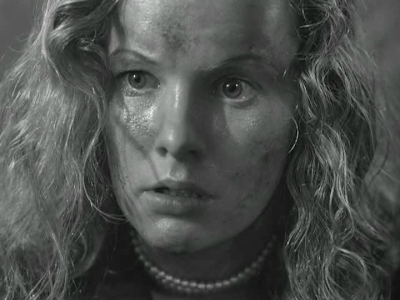
Gun Crazy could just as easily be known as Car Crazy, or better still, Wheels Crazy, because the two leads, Bart and Laurie spend lesser time in sticking-up than in making a getaway. Lewis expounds on their shared severe infatuation with weaponry – ‘We are together like’, Bart pauses and then pursues, ‘like gun and ammunition.’ It is the only analogy he is capable of. But while both the leads are obviously turned on by the smell of gunpowder, gasoline seems to do the job just as well. They spend most of the film driving, and both of them are darned good drivers, with Laurie having to use her entire tiny frame to propel the steering in a certain direction. Infact, it is only when they are not enclosed within the framework of a vehicle that they begin seeming dreadfully vulnerable – regardless of whether they possess their guns or not. 

Lewis uses the enormous time spent by the narrative in just lingering inside a car to make a major aesthetic departure from how scenes set inside a car were shot back in the day. By mounting the camera atop a jockey saddle in the back of the car, he shoots the occupants of the car from behind, instead of shooting them from the front with rear projection behind them. We see bona-fide American urban scenery through the windshield, the same as the actors do as they take a turn, or navigate through a rush hour – thereby effectively making us accomplices in their criminal spree by placing us in the backseat of the car. A simple jump across the axis elevates us to being adventurers, from being witnesses to an adventure. 


This is how they do it in Third-Person Shooters

Despite its blatantly stated moral dilemmas (the proverbial American indecision between uppity ideals and the extent of their applicability; or how it’s possible to tweak them as per convenience) Gun Crazy is primarily a statement on the nature of urge. 

Both the leads are gun-toting robbers, but Bart’s (John Dall by the way of James Dean) definition of his urge (or craze) is accurate – he shoots guns because he likes to shoot guns, while Laurie (Cummins, firebrand) shoots guns because of the authorial potency they afford her. Therefore, while Bart is satisfied shooting at empty cans, bottles, and circus-balloons, Laurie needs to point them at human beings to consummate their real ability as she understands it. 


Bowling for Columbine (2002) / Michael Moore
Her immoral influence as the corruptor of Bart’s small-town ideals make her a distant cousin of The Woman from the City, played by Margaret Livingstone in Murnau’s Sunrise. While Gun Crazy is clearly a tragedy – it is not one because the leads kill each other in the end (such relentless craze cannot but annihilate everything, in that it ends like Kiss Me Deadly) but because of the things that the annihilation renders incomplete. Their love story, most definitely, but also Laurie’s moral journey – she is a femme-fatale blooming into a heroine when she is shot dead by her own lover. She dies half-virgin, half-whore.


Wednesday, January 26, 2011

Danny Boyle's dilemma

How did they ever make a movie of this?
 
I suppose one could direct the story of 127 Hours as one of superhuman fortitude, or as a tragedy (a man forced to pay a premium in order to sustain his intense passion for something), or as one with a great deal of inherent irony. Boyle chooses the third; he had to choose the third: it is the only manner in which 127 Hours can exist as an entertaining feature film and not as an affecting short or a depressing (even sinister) short feature (as it would, if he were to make the first or the second choices). 

Boyle looks for opportunities in Aron Rolston’s tale to evoke in the audience a situation of ironic comparison – between the nature of their own immediate existence (plush, air-conditioned, spacious, pop-corn laden) with the canyoneer’s (confined, unheeded, famished).  And it is safe irony all through – the audience has the privilege of the foreknowledge of a character’s tragedy – they are in on the enormous joke all the time, so even as Rolston is stuck in the canyon, we get to survey the entire National Park through helicopter shots, or as he struggles to move an inch, we can simply lift ourselves out of the canyon on a crane. As he casually strolls to the location of his captivation (the canyon), the film becomes a series of shots that feature his right hand – through which we are reminded of the eventual amputation, and thus, made to smile nervously at the sheer irony of our potency as prophets in the life of our wholly unaware protagonist. Even more viciously, in the very first second of his five-day adventure, as the boulder incarcerates his right hand against the wall of the canyon, a title card is superimposed over the film – ‘127 Hours’ – you know, he doesn’t. Such gratuitous peddling of irony could be a yield of Boyle’s traditional love for superficial entertainment, but also his attendance of the first duty of a filmmaker as he understands it: to tell a good story. Strangely enough, the only factor that acts as a counterpoint to the complete immorality of his method is the audience’s foreknowledge of the character’s eventual escape: cinema often permits its audience to extract cheap thrills from a tragedy if they know that everything turned out well in the end.

However, it is not enough for Boyle to make Rolston feel gratified for his own life pre-tragedy, but wants to induce a similar gratitude in the audience – therefore, it is imperative that he arranges a common set of memories (or desires) for both Rolston and us to counterpoint the claustrophobic scenery of Rolston’s situation – he achieves it through the use of imagery from traditional advertising – imagery that belongs to us all. So Rolston’s memories of his family are substituted by the image of a ‘happy family’ like a cheap American car or board game ad might show it –  family on a sofa shot frontally in a lawn; a montage of images from cola ads proxies in/informs us of his thirst. He even has the average blonde lover to reminisce about – purely by reducing his past to a typical level does Boyle generalize it to the entire audience. 

127 Hours oscillates between these two methods of engagement with its audience: evoking the irony (almost Brechtian) inherent in their foreknowledge of the protagonist’s situation without ever implicating them for it, and somehow also making us ‘feel’ what he is feeling. That is because Boyle is, in varying qualities, a cynical sadist and a hopeful humanist. In the case of this film, unlike in Trainspotting or Slumdog Millionaire, a bit more of the former than the latter.


Monday, January 24, 2011

The 'Other' Type of Director

The Truman Show (1998)/ Peter Weir

"When you put it like that, yes. But I think some part of me is already rejecting it. I like to think each thing I’m finding is fresh. I’m not a stylist, pretty clearly. I’m that other type of director who serves the story, whose personal signature or name is not as important as [it is for] a singular artist whose films are, to a degree, about them: Fellini, obviously, or David Lynch. So I belong in that other group. In fact, if I get something that’s too close to something else [I've done], dealing with similar themes, I’ll reject it. But inevitably I’m dragging with me my own preoccupations and sensibility."

Peter Weir, Interview with Filmmaker Magazine

Sunday, January 23, 2011

Truffaut Letters - II


Truffaut wrote a letter to request Hitchcock's company


                                                                                                                             Paris, 2 June, 1962

Dear Mr.Hitchcock

First of all, allow me to remind you who I am. A few years ago, in late 1954, when I was a film journalist, I came with my friend Claude Chabrol to interview you at the Saint-Maurice studio where you were directing the post-synchronization of To Catch a Thief.  You asked us to go and wait for you in the studio bar, and it was then that,  in the excitement of having watched fifteen times in succession a ‘loop’ showing Brigitte Auber and Cary Graint in a speedboat, Chabrol and I fell into the frozen tank in the studio courtyard.

You very kindly agreed to postpone the interview which was conducted that same evening at your hotel.
 Subsequently, each time you visited Paris, I had the pleasure of meeting you with Odette Ferry, and the following year you even said to me, ‘Whenever I see ice cubes in a glass of whisky I think of you.’ One year after that, you invited me to come to New York for a few days and watch the shooting of The Wrong Man,  but I had to decline the invitation since, a few months after Claude Chabrol, I turned to film-making myself.

I have made three films, the first of which, The Four Hundred Blows, had, I believe, a certain success in Hollywood. The latest, Jules et Jim, is currently showing in New York.

I come now to the point of my letter. In the course of my discussions with foreign journalists and especially in New York, I have come to realize that their conception of your work is often very superficial. Moreover, the kind of propaganda that were responsible for in Cahiers du Cinéma was excellent as far as France was concerened, but inappropriate for America because it was too intellectual.

Since I have become a director myself, my admiration for you has in no way weakened; on the contrary, it has grown stronger and changed in nature. There are many directors with a love for the cinema, but what you possess is a love of celluloid itself and it is that which I would like to talk to you about.

I would like you to grant me a tape-recorded interview which would take about eight days to conduct and would add up to about thirty hours of recordings. The point of this would be to distil not a series of articles but an entire book which would be published simultaneously in New York (I would consider offering it, for example, to Simon and Schuster where I have some friends) and Paris (by Gallimard or Robert Laffont), then, probably later, more or less everywhere in the world.

If the idea were to appeal to you, and you agreed to do it, here is how I think we might proceed : I could come and stay for about ten days wherever it would be most convenient for you. From New York I would bring with me Miss Helen Scott who would be the ideal interpreter; she carries out simultaneous translations at such a speed that we would have the impression of speaking to one another without any intermediary and, working as she is at the French Film Office in New York, she is also completely familiar with the vocabulary of the cinema. She and I would take rooms in the hotel closest to your home or to whichever office you might arrange.

Here is the work schedule,. Just a very detailed interview in chronological order. To start with, some biographical notes, then the first jobs you had before entering the film industry, then your stay in Berlin. This would be followed by:

1.    the British silent films;
2.    the British sound films;
3.    the First American films for Selznick and the spy films;
4.    the Two ‘Translatlantic Pictures’;
5.    the Vistavision period
6.    from The Wrong Man to The Birds

The questions would focus more precisely on:

a)    the circumstances surrounding the inception of each film;
b)    the development and construction of the screenplay;
c)     the stylistic problems peculiar to each film;
d)    the situation of the film in relation to those preceding it;
e)    your own assessment of the artistic and commercial result in relation to your intentions.

There would be questions of a more general nature on : good and bad scripts, different styles of dialogue, the direction of actors, the art of editing, the development of new techniques, special effects and colour. These would be interspaced among the different categories in order to prevent any interruption in chronology.

The body of the work would be preceded by a text which I would write myself and which might be summarised as follows :  if, overnight, the cinema had to do without its soundtrack and become once again a silent art, then many directors would be forced into unemployment, but, among the survivors, there would be Alfred Hitchcock and everyone would realize at last that he is the greatest film director in the world.

If this project interests you, I would ask you to let me know how you would like us to proceed. I imagine that you are in the process of editing The Birds, and perhaps you would prefer to wait a while?

For my part, at the end of this year I am due to make my next film, an adaptation of a novel by Ray Bradbury, Fahrenheit 451, which is why I would prefer the interviews to take place between 15 July and 15 September 1962.

If you were to accept this proposition, I would gather together all the documents I would need to prepare the four or five hundred questions which I wish to ask you, and I would have the Brussels Cinematheque screen for me those films of yours with which I’m least familiar. That would take me about three weeks, which would mean I could be at your disposal from the beginning of July.

A few weeks after our interviews, the transcribed, edited and corrected text would be submitted to you in English so that you might make any corrections that you considered useful, and the book itself would be ready to come out by the end of this year.

Awaiting your reply, I beg you to accept, dear Mr Hitchcock, my profound admiration. I remain
                                                                                   
                                                                                                      Yours Sincerely,
                                                                                                  François Truffaut

Friday, January 21, 2011

Peeping Tom

A Director who meets,

An Actor, who stands in front of,
A Camera, which a director can use,
To Photograph, or,
To Direct in a Mid-Shot, or To Cut and,
To Direct in a Close-Up, Or To Edit, and have in his hands,
A Film
 
Peeping Tom (1960)/ Michael Powell

Thursday, January 20, 2011

Kaneto ShindĂ´: Images of Excess - I

Kaneto ShindĂ´
ShindĂ´’s images are full of glut of the most literal sort. He shoots human bodies as a director of a war film may shoot ammunition: objects that are as vulnerable to destruction as they are capable of it. As such, ShindĂ´ separates the purely corporeal nature of a human body from its spiritual one – much like directors of pornography or slashers – and thus, identifies them purely as material articles (and later debris).  Therefore, human bodies in a ShindĂ´ film do not belong to (or in ShindĂ´’s case, are controlled by) a human being who initiates/performs an action, but are often, centers of action themselves – as such, much like ammunition in a war film, they are battered, they batter, involved in fornication, destroyed, and in some cases, left to crumble – just like they are caressed, repaired, or manufactured. But through all of these, they can never relinquish their status as first and foremost, things with no greater purpose than mere existence (and whatever they can get in the course of it). In ShindĂ´ films, characters eat not to sate hunger, but to feed their bodies and keep the mechanism of the bodies functional. The characters in a ShindĂ´ film, ugly and always sweating profusely, look as if they belong to the machine yard – not as the workers who run the machines, but as the machines.

Some Shindo bodies, starting with Children of Hiroshima (1952)


And from Kuroneko (1968),


Also, of course, from Onibaba (1964)

While one may equate his treatment of human bodies as a sly form of objectification or even an aesthetical (perhaps moral) precursor to the torture porn that is peddled as horror in the cinema of today (Hostel and Saw, yes, but also the first six minutes of Saving Pvt. Ryan; gratuitous viscera as spectacle), he shoots faces like living entities. Thriving, blooming and flourishing entities. For ShindĂ´, the cut between a long-shot of a human body and a close-up of a human face is not merely a perfunctory or a liturgical exercise, but almost a complete change of scene – as if the two shots on either side of the cut contain two different entities altogether – as such, the cut from a long-shot to a face does not alter just the camera-subject distance, but ShindĂ´’s entire human approach towards the subjects of the two different shots. For while the long-shot contains the body that ShindĂ´ has nothing but vulgar disregard for, the close-up contains the intimidating face of a human being. It is in the long-shot that the ghost in a ShindĂ´ film lives; it is in the close-up that it becomes a horror. Fortunately for ShindĂ´, there is at least something that he finds worthy of regard (a human face). Unfortunately for him, he shoots it in a state of eternal suspicion.

Below, some of ShindĂ´’s faces - one from Kuroneko and the rest, Onibaba.


Shindo Face

Saturday, January 15, 2011

Kurosawa's Scope

The Bad Sleep Well (1960)

Kurosawa understood the nature of cinema or a motion picture at its most plastic and molecular level - as an assembly of pieces of film. As a result, a Kurosawa film may often resemble the most basic device of film itself : the film strip. More than anyone else's, it is easy to envision his films as moving 'horizontally' (i.e., the assemblage of the pieces of film, and not the chronology) The horizontal nature of his films is compounded by the infamous usage of the 'horizontal wipe' transition - wherein one image would be pushed into oblivion  another, oncoming one, that would slide in from the right. More than that, however, he lent his film a strictly horizontal quality by composing in the TohoScope - the Japanese comeback to the Cinemascope. 

While the American understanding of the 'Scope was rather businessman-like, and focused  on 'scale' (like Americans often are), Kurosawa's reception of the aspect-ratio was that of the mountaineer faced with a greater height. If the American approach was that of accommodation, his was one of placement. The West took to the Scope as a bigger boat - one that can fit in more people (the method of quantity), directors in the east sought to fit in the same number of people as earlier, but arrange them on the frame area in a manner that created more 'points of action' in the frame - a quality of the Scope that Tati brought to consummation with Playtime.

Following are a few images from one of the earlier Kurosawa works shot on a TohoScope - The Bad Sleep Well.  The final image is that of Mifune standing in the background of the image (the Japanese graphic art is composed often in three planes) on a garbage heap as two characters converse in the fore. Mifune was a beast of a man - one of the few who could suggest more than just the presence of a  human body when placed in a cinematic long-shot - Kurosawa used this quality in all the films he made with Mifune.


 And the 'beast'.