Showing posts with label Ideas. Show all posts

Sunday, July 31, 2011

Levels of Lying

Real Life (1979) / Albert Brooks

Instead of letting the interplay between ‘real’ and ‘fake’ (or Hollywood, as Brooks emphasises) in his film assume Kiarostamiesque-proportions¸ he chooses to engage plot-based mechanics, thereby resulting in a film that is almost always on the verge of profundity, but ends up being only a ‘entertainer’. There are curious qualities of self-referentialism in the film, with the format of the film consistently folding upon itself. It is a film about a narcissistic and selfish manipulator who feigns verisimilitude but instead, begins to intrude or influence the subject of his film so as be able to capture ‘tension’. There might only be two ways to direct the film ofcourse:  you could claim the stature of a faux-documentary and aver that the film is ‘really’ a record of a wholly authentic sociological experiment, or you could make a fiction film (one part comio-thriller, one part chamber drama, one part satire, one part dystopia) about a director who claims to shoot the real life of a family over the period of an year. Brooks starts out choosing the former approach, but ends up with the latter – because perhaps, much like the director he plays in the film, he loses trust in his own method easily. All said, however, Real Life is one of the greatest films about film direction and one of the better films about megalomaniacs (at par with Aguirre : The Wrath of God, one up on The Great Dictator and one down on Three Colours : Red) who are wholly incapable of fulfilling their ambition of megalomania. The assignment of a divine role to the filmmaker is, infact, a theme constant in the film. Brooks tells the head-of-family that is the subject of his record : ‘To err is human, to film, divine’.

Sunday, July 24, 2011

Newsreel Days


Zelig (1983) / Woody Allen
The driving force of the film, apart from its Forrest Gump-ish devotion to following the wholly inadvertent influence of a simple-man on the construction of pop-culture, is nostalgia. Much like The Purple Rose of Cairo (1985), Radio Days (1987) and Shadows and Fog (1992), Allen’s period-film is essentially whatever he remembers of the period – a factual depiction distilled through a personal recollection. It is absolutely vital, obviously, that Zelig is a character from the past – a myth that is not absolute – a notion that seeps in to the present through the pores of grainy newsreel footage, because only then can he be speculated upon, or because only then can his story be ‘told’ by various people. Allen cheekily gets the subjects of his faux-vox populi to speak of how Zelig will essentially only remain a symbol – as if to discourage the viewers of the film from coming up with their own interpretations (he even interviews Sontag herself.) But quite crucially so, it is impossible to, because for all its worth, Zelig is definitely the most dense of all Allen films – and one of the shortest. The character of Leonard Zelig symbolizes a lot – the liberation of the far-left and the conservatism of the far-right, America and the rest, the vice of conformism and the gift of individuality, and because it is an Allen film – the literary allusions : Zelig as the Kafka-esque man who must fit into whatever mould the society demands of him, as also the Dostoevsky protagonist who must perform arduous labour to discover his true ‘identity’. Ofcourse, the greatest accomplishment of Zelig is not how it cleverly turns a clearly sensational second-rate science-fiction plot into a film about love and its healing power – but that in it, Allen is mostly playing a lot of people, but not Allen himself.

Saturday, July 16, 2011

American Soviets

  
Notes on Days of Glory (1943) by Jacques Tourneur:
  • In a war film, the Nazis are always a fuzzy abstraction – there is no enemy to ‘see’ or to ‘speak of’, no single individual we can lay our entire moral blame on, and no one to condemn – because it is to be understood that it the protagonists’ war is a noble one if it is against ‘them Nazis!’. A film, however, may go a step ahead and actually show the only Nazi in the world we actually know – Hitler.
  • Much like Inglorious Basterds, the alignment of our empathy is guided through spoken language – we are to side with whoever speaks a language from ‘closer home’. Therefore, the Soviet soldiers speak in English (a linguistic anomaly) and the Nazis speak in German (a linguistic gambit) because while the former is a move to endear, the latter is a move to alienate. Notwithstanding ofcourse that the Soviets speak English in a Kentucky accent; it doesn’t matter.
  • Days of Glory is a rather American film about a group of Soviet soldiers. A war film is a marketplace of ideas – an Indian war film is about selfless, almost lunatic nationalism, the European war film is absurdist theatre, the Soviet war film is a statement about loss of innocence – the American war-film is, buoyed by imaginary victories in all wars they fought, glorious propaganda. By the halfway mark, the Soviet soldiers get rid of their particularly Communist virtue: a lifeless and almost militant devotion to an intangible ideal, and embrace the American idea: one says to another, ‘You have taught me how to live again!’, thereby restoring humanity in the human. There are also the stout comic sideys who keep pulling off visual gags now and then. 
  • The end of the film, however, restores far-leftist insanity in the film – the merry band of soldiers begin delirious sneering and sloganeering and oath-taking as a Nazi tank approaches their stronghold. Such madcap adherence to meaningless ideas (Tourneur makes the sound of the approaching tank so loud that we cannot even hear what the soldiers are saying) in the face of imminent death suddenly converts a dreary, boring, messy American war film into a vital, thriving, animated European war-satire. The heroes are converted into total yuppie-idiots who ride the nuclear warhead while ‘yippie-ki-yaying’ their way to death.
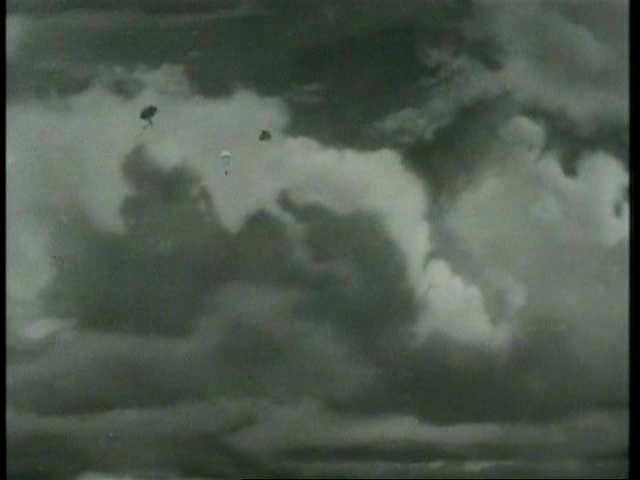
  • There is also one of the strangest shots in all of cinema - almost serene and definitely surreal - as Vladimir looks in the far distance from within the foliage, a Nazi plane is engulfed by anti-aircraft fire. Small dark-grey ruptures around the distant plane suggest misfired projectiles, until one gets the plane – it explodes in the sky and out of it, supported under a neon-white parachute, a pilot descends to safety, until ofcourse, as soon as a hysterical Vladimir wishes it – a projectile gets the pilot too. It is a picture of incredible devastation – and yet, we do not know either the pilot, or the man who fired at him from the ground. Our investment is purely sensual; much like Vladimir's. In the next scene, a comrade admonishes himfor beginning to enjoy 'violence', much like we just did.
 

Wednesday, June 15, 2011

On Cattle-Rearing

Red River (1948)/ Howard Hawks
At certain unique, yet not wholly indistinct levels, both Red River and The Searchers are about the same thing: the things a man may discover about himself while in a state of transit. Convention may define both of them as road films, therefore; but they depart from the ‘road film’ in their establishment of a fixed objective that the journey is meant to attain. In Red River, Wayne and his band must find a suitable market to sell the 9000-strong members of their cattle-herd, while in The Searchers, Wayne must retrieve a young girl from the captivity of a native Indian tribal leader. Both films are rather specifically the product of their times; even if in a wholly Hollywood-manner, i.e., in interlinked catacombs of subtexts, underlying meanings and implicit meanings. The old-timey filmmakers functioned in a manner by which they could work up a healthy pretense of the ‘paramount premise’: plot details that are presented as objects of utmost urgency, a story that requires immediate telling. But with directors like Hawks or Wilder sometimes and Welles or Huston, most of the times; details of the ‘paramount premise’ would only obscure an agenda, instead of revealing it whole-handedly. In Red River, the agenda is clearly a right-winger’s definition of ‘manliness’: that of one who brands cattle as his own, beats native Indians in gun-fights, asks a woman to bear him his son, and is involve in a consistent animalistic battle for ‘territory’. It is not the defeat of a patriarchal code as many may read it, but the upgradation of it. 

The patriarch is no-longer the Herzog-hero: borderline senile, excessively principled, a fascist commander who is played by John Wayne in the film; but a vulnerable, malleable, more centrist youngster played by Montgomery Clift – so even though Joanne Dru does a ‘Rosie the Riveter’, and becomes a representation of the post-war American woman when she points a gun at the two brawling men and tells them get their act together – the patriarch is still very much intact. There are signs, in fact, that while Clift’s young leader might seem an overhaul of Wayne’s old dictator; he is infact, only a replacement. Even as the film ends, Wayne’s Dunson does not concede his error or admit the fallibility of his ideology, but in fact, assures Clift’s Garth that their cattle will now also be branded with his initial, because apparently, he ‘has earned it.’ In that moment, the film ceases to remain about a larger theme, and instead, becomes a father-son story, with each trying to stress his ‘masculinity’. But Red River’s masculinity is peculiar too, because the greater man is not the one who draws a gun faster, but that who can rear cattle better.