Showing posts with label American Cinema. Show all posts

Thursday, April 11, 2013

Two-Faced Jerks

Underworld U.S.A (1961) / Samuel Fuller

There is a sequence of immense cruelty in Fuller’s film – a dying man who has murdered the protagonist’s father asks him for forgiveness, ‘I gotta die with a clean slate’, he tells him and clutches onto the younger, more alive man’s coat-lapel as a plea. In return, the protagonist, who has gotten himself implicated (and therefore, in prison) repeatedly over the years only to preserve proximity with the dying man (since he’s been serving a life-term), asks for the names of the other three men involved in the murder. He presses onto the older man to the point of blackmail, repeatedly reminding him of possible post-death retribution in case he does not give his partners up. With the terms of the barter agreeable to both parties involved, the old man proceeds to rat. He then demands of the other man to keep his side of the bargain, at which point, the younger man takes the dying man’s hand and severs it from his coat-lapel, letting him die with blood on his hands. He does the dishonourable act by lying to a man on his deathbed – but the thing with Fuller is, there isn’t much honour at any rate, there is no glory or pride too; there is only dignity and individuals trying to salvage whatever little of it they can. The protagonist’s been the liar in this scene, the two-faced jerk, but who’s to say about the old man prepared to divulge the identities of his partners for an entirely selfish purpose – only because he’s dying and well, death means there aren’t any stakes involved anymore. Fuller will confuse the issue even more; the old man’s desire for forgiveness is entirely hokey – he is, after all, the man who murdered a father in front of his child and ended his possibilities for a normal adulthood. In that, Fuller is clear that the dying man’s more successful murdering partners – Gela, Gunther and Smith – who are honest (and even proud) of their criminal excursions are more admirable than this sniveling old man who believes an afterlife remission will save him. 

Saturday, November 12, 2011

Violations

Miller's Crossing (1990) / Joel Coen and Ethan Coen

At one level or the other, the garment of all Coen Bros. films is woven around a discussion of the sustainability of a spoken (and not documented) agreement: as such, the characters are supposed to honour an established regimen – a grand central unifying code-of-life. A Coen Bros. film, however, begins at the last straw: the characters are already paying remittances for their past follies and their past debts. When Miller’s Crossing begins, Leo and Tony have already been in legion with each other for years or H.I. is already in the penitentiary when Raising Arizona begins – the Coens are more interested in implications of a position instead of origin-stories and recollections. As such, the grand code between the characters has been set from before the film starts – what we are called onto witness is the different manners of its transgression.

In that, Miller’s Crossing is the prototypical Coen Bros. film, because it is at its most fundamental about one thing: loyalties among men. That sort of (simultaneously) schlock and hard-sell lends itself easily to the gangster-movie format, because the universe of such a film is full of individuals who make grand commitments, but never on paper (for all of The Godfather trilogy’s crime syndicate-corporate family insinuations and Goodfellas’ flaunting of a large ‘network’ of crime – no one ever signs a piece of paper). Instead, they are merely Jewish businessmen handshakes, gentlemen’s agreements, the law of the spoken word – where one must (and is expected to) stick to a commitment he made. 

Invariably, however, in each gangster film, someone will violate the terms of this harmonious accord: someone will rat, someone will want to usurp control, someone will generally be a dick – but while in a lot of gangster films, such violations act as narrative-triggers or plot-devices that can then justify the murder-mayhem that will follow; a Coen Bros. film will turn it into a solemn discussion of human virtues (or the lack of it). Therefore, when Tom Regan decides to play the grand-schemer-manipulator – setting one up with two, two with three, one with three – he enters into a network of double and triple crosses – a network of transgressions, thereby setting up multiple debates at the same time. One about ethics (Johnny Casper says: ‘It is now a matter of whether he is ethical or not’, about a trusted cohort), the other about morality (Verna says to Tom: ‘You always break…’ and lastly, humanity itself (Bernie to Tom: ‘Look inside your heart’. Reply: What heart?’). It is absolutely clear by the end, obviously, that he, the most disloyal of all, is the most loyal – he merely does not honor minor accords in the face of his devotion to a grander monolith. 

Eventually, it is wholly natural for the Coens to conduct, at a seething regularity such discussions – their collective identity as filmmakers being about projecting a small-town admiration for simple virtues into the big bad world of Hollywood. That the device they choose to set such a discussion up is invariably the tenacity of a male bond is interesting too – their own creative partnership, after all, functioned for the first half of their career based on the agreement that only one of them get the credit for direction.

Sunday, September 11, 2011

The Sound Basilica


My Man Godfrey (1936) / Gregory La Cava

My Man Godfrey (1936) may very well be declared devoid of any particular ambition: the social satire is as soggy as a teenage political protestor’s manifesto; the performances range from absolute hysteria to calculated mystery, there is no soundtrack, there is no particular purposefulness with the camera (though, a lot, with the manner in which actors move in relation to it) – but it is still one of the most significant films ever – because it demonstrates properly, unlike a lot of other films from its era, the manner in which a soundstage may effectively be employed. The idea of a soundstage may be understood as a bank every inch of whose floor is wired with an alarm sensor – each inch of its area sensitive to a touch that may evoke a startle – similarly, a sound may be picked anywhere on a soundstage, even if one were to speak in the background, or better still, from outside the frame itself. This quality of sound is not used in cinema much even now – and it is most often the source-distance from the camera that determines the level of sound it may emanate – therefore, since the mainstream almost always films its characters in the foreground, the sound of the scene also belongs to only one plane-of-action. But what La Cava does with Godfrey, apart from choreographing some of the most elaborate background action in cinema (no one is irrelevant in the frame, no one is provisional, the actors even in the far-background are relevant contributors to the scene), is that he choreographs background-sound as well – therefore, the sound is not merely three-dimensional (which the speaker-system in a theatre ensures), but also three-planar i.e., emanating from three planes of action, and ofcourse, from the off-screen. Which is particularly relevant too in the case of this film, because if it were to be defined as such, it is a screwball comedy – and more than any other film, depends for its humour on dialogue exchanges, monologues, sighs, grunts, queer laughters, and in general, dialogue-mayhem – therefore, La Cava takes care to ‘record’ each sound on the stage and the put it in the film too. The players in the film are perpetually speaking (or affecting a sound) – one dialogue exchange happens in the foreground, yes, but at the same time, you can hear someone crying hysterically in the background, and in some other room altogether, someone else conducting yet another affair – in a rare case in cinema then, it is the sound that evokes the image, and not the other way round.

Wednesday, August 24, 2011

Othellos

Modern Romance (1981) / Albert Brooks


The crucial distinction between Robert Cole of Modern Romance and Jake La Motta of Raging Bull, both jealous, perpetually paranoid men who are mistrustful of their respective women, is anthropological. Cole is an early 80s, latter-day Californian who works in a modern profession – film; La Motta is a early 40s, early-day New Yorker from Bronx who performs in a primitive profession – professional fighting. Of course, probed deeper, both filmmaking and boxing are essentially the same: thoroughly passionate systems of expression where the participants use automatic instinct that is informed by years of rigor (both physical and cerebral). Cole attempts to dilute jealousy-pangs by biting into a culture that claims be able to heal his heart by replacing love with a pair of sneakers; La Motta does it by pummeling other men. Cole is, however, a man of rationale, a film editor, one whose job is to locate reason in chaos – he can, at every step, justify his immense insecurity by announcing it as a feature of modern romance, thereby smudging an entire era with the misgivings of his psyche; La Motta, on the other hand, suffers from the simple-minded entitlement of a mid-20th century animal, he believes his wife is a territory no one trespasses. Ofcourse, they are similar men, and what would be hilarious is to replace one with another : Cole in the boxing ring, employing the sane forces of logic and rationale and  La Motta in the editing suite, smackin’ the foley-guys who mock his utter lack of talent. By the way of trivia, the director of Raging Bull directed the director of Modern Romance  in another film where Brooks plays the insecure, jealous aspiring lover: but there, he is always in the background, stealing furtive glances in the way of the girl as a crazy taxi-man in a red blazer takes her away from right under his nose.

Monday, August 15, 2011

This, that and then that.

The reason the sequence of the payroll robbery in Siodmak’s The Killers is one of the greatest in all of cinema is because it, at first, teeters succinctly between, and later, encompasses aesthetic approach(es) required to fulfill successfully: news reel reportage, crowd-direction, dirty action sequence, a thrilling getaway and finally, a moment of human compassion. Siodmak’s decision to shoot the entire bank-robbery in one single-take has major repercussions; it is definitely, and above all, a technical victory of the crane, but the variety of critical notions it invokes is staggering: simultaneously, the Bazinian notion of ‘realism’ without relinquishing ‘style’, the Cahiers notion of the film director as the controller, master, choreographer of the universe, the Penelope Houston notion of cinema being about ‘human emotions’ and most essentially, the Daney notion of the image being what ‘we see’, or what the director ‘shows’.

An insurance detective (O’Brien), to strengthen his belief that the murder of a two-bit Swedish hustler deserves more time because there ‘is more’, asks the boss of his insurance company to read a newspaper report from five years ago about a payroll-robbery in a hats factory – the boss, entirely unconvinced, begins reading. As soon as he does, the image eagerly fades into a flashback where we can see the events of the robbery first-hand. The narration of the boss reading the newspaper report (written, always, in simple past) in the movie-present is superimposed over the sequence of the robbery that takes place in the movie-past. The players perform within the image as and when the audio track provides them with a certain cue; if you were to watch the film with subtitles on, the subtitled text slowly becomes the caption of the image you ‘see’. As such, Siodmak lays bare the most essential function of modern-day, Jamesian notion of writing: invoking a series of visuals, or to assist the reader in ‘visualising’ what he reads.

Of course, as captions go, Siodmak shows only the fleeting moment in time that is most integral (or is the best visual representative of) to what line of text the ‘to-the-point’ newspaper report the insurance boss is reading.  


Such generous respect is extended to simple-minded causality throughout the film. It is like making a film in the short-hand : to show, what is ‘essential’ (Dassin), while pretending to possess a vantage-point that can see ‘everything’ (Ophuls). The story of the film begins, infact, with three shots that do not play in quick succession, but still, fulfill the most basic tenets of the Japanese woodblock paintings that form the basis of the Soviet Montage. The first shot is of two men driving, the second of a street-sign which reads ‘Brentwood’ and the third of the shadows of two men lurking on the streets of a foggy-old nondescript town. Once you take the first and the second together, it is easy to deduct that the two men have now reached Brentwood.

Other instances of meticulous causality, or relevance of the small-moment is strewn throughout the film. In this one, the insurance detective points his gun (those were simpler times, simple etiquette dictated that whoever had the gun would control the conversation) at one of the members of the payroll-robbery party, Dum-Dum. Dum-Dum answers his questions for a while and then asks for his permission to smoke. In a very careful and crucial moment, he decides to rest one of his leg onto the other – this small move will determine who will control the conversation next.


While on the topic, see also: this.

Sunday, July 31, 2011

Levels of Lying

Real Life (1979) / Albert Brooks

Instead of letting the interplay between ‘real’ and ‘fake’ (or Hollywood, as Brooks emphasises) in his film assume Kiarostamiesque-proportions¸ he chooses to engage plot-based mechanics, thereby resulting in a film that is almost always on the verge of profundity, but ends up being only a ‘entertainer’. There are curious qualities of self-referentialism in the film, with the format of the film consistently folding upon itself. It is a film about a narcissistic and selfish manipulator who feigns verisimilitude but instead, begins to intrude or influence the subject of his film so as be able to capture ‘tension’. There might only be two ways to direct the film ofcourse:  you could claim the stature of a faux-documentary and aver that the film is ‘really’ a record of a wholly authentic sociological experiment, or you could make a fiction film (one part comio-thriller, one part chamber drama, one part satire, one part dystopia) about a director who claims to shoot the real life of a family over the period of an year. Brooks starts out choosing the former approach, but ends up with the latter – because perhaps, much like the director he plays in the film, he loses trust in his own method easily. All said, however, Real Life is one of the greatest films about film direction and one of the better films about megalomaniacs (at par with Aguirre : The Wrath of God, one up on The Great Dictator and one down on Three Colours : Red) who are wholly incapable of fulfilling their ambition of megalomania. The assignment of a divine role to the filmmaker is, infact, a theme constant in the film. Brooks tells the head-of-family that is the subject of his record : ‘To err is human, to film, divine’.

Sunday, July 24, 2011

Newsreel Days


Zelig (1983) / Woody Allen
The driving force of the film, apart from its Forrest Gump-ish devotion to following the wholly inadvertent influence of a simple-man on the construction of pop-culture, is nostalgia. Much like The Purple Rose of Cairo (1985), Radio Days (1987) and Shadows and Fog (1992), Allen’s period-film is essentially whatever he remembers of the period – a factual depiction distilled through a personal recollection. It is absolutely vital, obviously, that Zelig is a character from the past – a myth that is not absolute – a notion that seeps in to the present through the pores of grainy newsreel footage, because only then can he be speculated upon, or because only then can his story be ‘told’ by various people. Allen cheekily gets the subjects of his faux-vox populi to speak of how Zelig will essentially only remain a symbol – as if to discourage the viewers of the film from coming up with their own interpretations (he even interviews Sontag herself.) But quite crucially so, it is impossible to, because for all its worth, Zelig is definitely the most dense of all Allen films – and one of the shortest. The character of Leonard Zelig symbolizes a lot – the liberation of the far-left and the conservatism of the far-right, America and the rest, the vice of conformism and the gift of individuality, and because it is an Allen film – the literary allusions : Zelig as the Kafka-esque man who must fit into whatever mould the society demands of him, as also the Dostoevsky protagonist who must perform arduous labour to discover his true ‘identity’. Ofcourse, the greatest accomplishment of Zelig is not how it cleverly turns a clearly sensational second-rate science-fiction plot into a film about love and its healing power – but that in it, Allen is mostly playing a lot of people, but not Allen himself.

Saturday, July 16, 2011

American Soviets

  
Notes on Days of Glory (1943) by Jacques Tourneur:
  • In a war film, the Nazis are always a fuzzy abstraction – there is no enemy to ‘see’ or to ‘speak of’, no single individual we can lay our entire moral blame on, and no one to condemn – because it is to be understood that it the protagonists’ war is a noble one if it is against ‘them Nazis!’. A film, however, may go a step ahead and actually show the only Nazi in the world we actually know – Hitler.
  • Much like Inglorious Basterds, the alignment of our empathy is guided through spoken language – we are to side with whoever speaks a language from ‘closer home’. Therefore, the Soviet soldiers speak in English (a linguistic anomaly) and the Nazis speak in German (a linguistic gambit) because while the former is a move to endear, the latter is a move to alienate. Notwithstanding ofcourse that the Soviets speak English in a Kentucky accent; it doesn’t matter.
  • Days of Glory is a rather American film about a group of Soviet soldiers. A war film is a marketplace of ideas – an Indian war film is about selfless, almost lunatic nationalism, the European war film is absurdist theatre, the Soviet war film is a statement about loss of innocence – the American war-film is, buoyed by imaginary victories in all wars they fought, glorious propaganda. By the halfway mark, the Soviet soldiers get rid of their particularly Communist virtue: a lifeless and almost militant devotion to an intangible ideal, and embrace the American idea: one says to another, ‘You have taught me how to live again!’, thereby restoring humanity in the human. There are also the stout comic sideys who keep pulling off visual gags now and then. 
  • The end of the film, however, restores far-leftist insanity in the film – the merry band of soldiers begin delirious sneering and sloganeering and oath-taking as a Nazi tank approaches their stronghold. Such madcap adherence to meaningless ideas (Tourneur makes the sound of the approaching tank so loud that we cannot even hear what the soldiers are saying) in the face of imminent death suddenly converts a dreary, boring, messy American war film into a vital, thriving, animated European war-satire. The heroes are converted into total yuppie-idiots who ride the nuclear warhead while ‘yippie-ki-yaying’ their way to death.
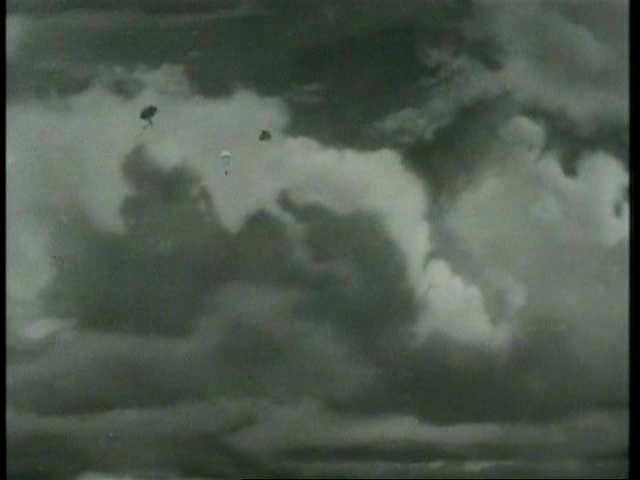
  • There is also one of the strangest shots in all of cinema - almost serene and definitely surreal - as Vladimir looks in the far distance from within the foliage, a Nazi plane is engulfed by anti-aircraft fire. Small dark-grey ruptures around the distant plane suggest misfired projectiles, until one gets the plane – it explodes in the sky and out of it, supported under a neon-white parachute, a pilot descends to safety, until ofcourse, as soon as a hysterical Vladimir wishes it – a projectile gets the pilot too. It is a picture of incredible devastation – and yet, we do not know either the pilot, or the man who fired at him from the ground. Our investment is purely sensual; much like Vladimir's. In the next scene, a comrade admonishes himfor beginning to enjoy 'violence', much like we just did.
 

Saturday, July 2, 2011

Ego-Wars


World for Ransom(1954) / Robert Aldrich
Like Aldrich films go, World for Ransom is seen best on a faded print, which seems to enhance, somehow, the foggy, almost vapour-ridden nature of the universe inside which the film is set. The film resembles, at best, a state of exhausted delirium, a night in the winter of a north-Indian small town, and while a lot of ‘action’ takes place, it is never inexorable – each scene of a major ‘event’ is followed by one where two characters or more settle down and discuss the progress of the plot thus far. Made on the sidelines of the television show China Smith (1952), World for Ransom combines aesthetics of an action-film (continuous action, evolving plot) with that of television (the most major surprises to be revealed during simple conversation).  The location for the film is peculiar – it is set in Singapore (rather generic too, the Asian guys are called Wong and Chan) – the villain remarks: ‘What I am doing must be done along the Iron Curtain”; such fantastic alignment of verb with noun, geography with politics, a definite purpose with an abstract idea, is typical of the film. 

Similar to Kiss Me Deadly that he made a year later, the bomb is only an allegory, any of the two power blocs may secure the secret of the hydrogen bomb just like the shifty heroine cannot make up her mind between her former lover and her shady husband.


The wife, the lover and the husband as the looming presence.
She is a 60s Fuller-protagonist, and controls the entire plot of the film from inside her household, even as the foolish noir-hero goes about getting implicated for murders, beaten up by thugs and getting involved in firefights that involve grenades and sten-guns, only to impress her – the larger idea is obvious : you can solve a massive diplomatic row, rescue a major scientist, kill a number of trained soldiers and save the world from certain nuclear holocaust, but if the girl rejects you, what is the point?

Wednesday, June 15, 2011

On Cattle-Rearing

Red River (1948)/ Howard Hawks
At certain unique, yet not wholly indistinct levels, both Red River and The Searchers are about the same thing: the things a man may discover about himself while in a state of transit. Convention may define both of them as road films, therefore; but they depart from the ‘road film’ in their establishment of a fixed objective that the journey is meant to attain. In Red River, Wayne and his band must find a suitable market to sell the 9000-strong members of their cattle-herd, while in The Searchers, Wayne must retrieve a young girl from the captivity of a native Indian tribal leader. Both films are rather specifically the product of their times; even if in a wholly Hollywood-manner, i.e., in interlinked catacombs of subtexts, underlying meanings and implicit meanings. The old-timey filmmakers functioned in a manner by which they could work up a healthy pretense of the ‘paramount premise’: plot details that are presented as objects of utmost urgency, a story that requires immediate telling. But with directors like Hawks or Wilder sometimes and Welles or Huston, most of the times; details of the ‘paramount premise’ would only obscure an agenda, instead of revealing it whole-handedly. In Red River, the agenda is clearly a right-winger’s definition of ‘manliness’: that of one who brands cattle as his own, beats native Indians in gun-fights, asks a woman to bear him his son, and is involve in a consistent animalistic battle for ‘territory’. It is not the defeat of a patriarchal code as many may read it, but the upgradation of it. 

The patriarch is no-longer the Herzog-hero: borderline senile, excessively principled, a fascist commander who is played by John Wayne in the film; but a vulnerable, malleable, more centrist youngster played by Montgomery Clift – so even though Joanne Dru does a ‘Rosie the Riveter’, and becomes a representation of the post-war American woman when she points a gun at the two brawling men and tells them get their act together – the patriarch is still very much intact. There are signs, in fact, that while Clift’s young leader might seem an overhaul of Wayne’s old dictator; he is infact, only a replacement. Even as the film ends, Wayne’s Dunson does not concede his error or admit the fallibility of his ideology, but in fact, assures Clift’s Garth that their cattle will now also be branded with his initial, because apparently, he ‘has earned it.’ In that moment, the film ceases to remain about a larger theme, and instead, becomes a father-son story, with each trying to stress his ‘masculinity’. But Red River’s masculinity is peculiar too, because the greater man is not the one who draws a gun faster, but that who can rear cattle better.

Sunday, May 8, 2011

Kindling Temperature

Inglourious Basterds (2009) / Quentin Tarantino
2009’s World-War II magnum opus, Inglourious Basterds, founds itself completely on small points of contact between two alien cultures. It is a global film for a globalised world about a time when the world wasn’t so globalized. Each character in the film is a new ‘fish’, challenged by the prospect of adoption of a new custom (represented in the film, more or less by spoken language. It’s Tarantino, what else?), and the chances of survival of a new character depends entirely on how well it can adopt to the world outside its ‘water’. Col. Hans Landa (Christoph Waltz), the primary antagonist of the film, does it the best, and so he survives the longest. Tarantino being Tarantino, cannot relinquish entirely the debt the cinema of the present owes to the cinema of the past, and therefore, he cannot help but try to construct a few classical Hollywood type gags based on the uneasy interaction between members of two different cultures (uneasy because clearly, they would much rather be sitting at home than fighting the war); but almost always has to follow it up with great urgency an event of a clearly more sinister intent.
 
Sgt. Donny Donowitz (Eli Roth) messes up his Italian pronunciation and it is funny, but it also results in giving away Aldo Raine (Brad Pitt)’s identity to the Nazis. The point of contact between two vastly different cultures resulted in a short gag earlier, but in contemporary cinema, it is the game-shifter. A second of hesitation on the part of the alien can result in complete anarchy. The narrative does not break for snacks (as it would, in case of a gag), but is entirely and utterly annihilated and replaced by a newer one. In this regard, the narrative no longer remains a tangible coherent idea, but only a notion – meant to be replaced by another notion. Each major event in the film (mostly an all-consuming shootout) is a result of some character or the other committing a single mistake and revealing his/her true identity. It is funny because for a film set in a period of vast ideological disparity, it is completely about more tangible differences; and thus, in a rather bleak manner, declares humanity incapable of internal reconciliation.

Tuesday, April 26, 2011

JJ, where will your soul rest?

Mystery Train (1989)/Jim Jarmusch
Throughout his first two films, Permanent Vacation and Stranger than Paradise, Jarmusch devotes most of his filmic time to following his characters around as they travel (bum) around (rooftops, terraces, by lanes, seedy theatres in Vacation; New York, Cleveland and then Florida in Paradise.). His films can thus be, in the most literal sense of the word, a relentless pursuit. But the relentlessness in a Jarmusch film is not a yield of an underlying grand conviction in the multi-dimensional human being. He starts with the standpoint of someone who is making a film about bums, losers incapable of a greater discovery – but what is so endearing about a Jarmusch film is how he asserts a belief that it is infact, completely cool to be a bum. One, his cinema believes, is not obliged to radiate a glowing virtue that bathes the audience in his light. His films are people in a constant state of voyage – journeymen who wander for the fulfillment of an unfulfilled higher goal – constantly traversing through different spaces. But at least until the end of his third feature, Down by Law (and even there, grudgingly), the journey never really condenses into any destination. The search, or whatever it is that the characters are searching for, just never seems to be consummated (“We come all the way to Cleveland, but it all looks so same.”) – as such, his films end in a state of transit, in an open space, with characters that seem to be travelling on a route with frayed ends; never-ending and devoid of any destination – a quality of his work manifest most blatantly in the vignette film Night on Earth, in which characters actually occupy a mode of transit (a taxi) as they participate in the conduct of a narrative, or even his Mystery Train, where the film ends with characters inside the eponymous train.

Wednesday, March 23, 2011

Tourneur's Scope


Days of Glory (1944)/ Jacques Tourneur

Academic interest : one of the first instances in cinema in which the bullet being fired and subsequently locating its target, i.e. the entire trajectory of the projectile, is featured in one continuous shot.

Cultural interest : the victim; the sniper in the crosshairs is aiming at someone off-screen, someone we will never know. He does not intend any harm whatsoever to the person who eventually shoots him. Such pandering of an ironic circumstance, and the foreboding sense of being 'caught unawares' are typical Tourneur tics.

Saturday, March 12, 2011

Notes on Black Swan

Black Swan (2010) / Darren Aronofsky
  • Aronofsky has a continuing interest in the human body. But it is interest akin to Poe’s, and not to Allende’s. As such, he is not fascinated by its perfect symmetry, but intimidated by it. Therefore, it is imperative that he employ, in each film, a human body whose symmetry undergoes a devastating transformation, more or less to assume a form that Aronofsky can endear himself to more easily. Good-looking (in the traditional definition of the phrase) actors must populate an Aronofsky landscape, because it is corporeal perfection that he wages an artistic battle against. It is easy to categorise his cinema as ‘body horror’, also because he easily sacrifices metaphysics for materialism.
  • No matter how profound the topic of the film, Aronofsky can only discuss it at its most literal. There is no subtext, or the image is its own subtext. Thus, Aronofsky is the filmmaker whose aesthetic is the most rooted in ‘pop culture’ – because what you see is the only artifact. If a guy abuses narcotics, he must have his arm amputated sooner or later/ if a wrestler with a condition cannot stop fighting, he will die of a heart disease eventually/ if a dancer becomes the black swan, she really will sprout wings. There is no place for philosophy in an Aronofsky film, because for Aronofsky, a film shows and philosophy is read.
  • Both The Wrestler and Black Swan sprout the notion of personal art, i.e. art whose definition might be constituted differently for different people; which is to say – ‘to each his own art’. The films, however, are not about obsessive pursuit of art, but obsessive pursuit of art as a getaway route. Art as a refuge from the dreariness (in case of The Wrestler) or suppression (in case of Swan) of ‘real’ life. Both the ‘performers’ thus, treat performance as a means to escape from ‘reality’.
  • There are instances in all of his films of physiognomy. There are close-ups, both in The Wrestler and in Black Swan of ‘additions’ to the human body that enhance its owner’s performance in their respective vocations – in the former, his skin gets impaled with weaponry of the primal sort; in Swan, feather follicles emerge from her scars. The ‘body’ takes precedence over all else (as point a) says), but only in Black Swan do the effects of such precedence manifest in Aronofsky’s aesthetic. There are perhaps (excluding the final on-stage performance) six long-shots in the entire film. Most of it is conducted in close-ups or mid-shots, done, presumably in long lenses. Such proximity to the human body is uncomfortable, and psychologically disorienting, because of the inherent claustrophobia of the arrangement, but also because it makes us more privy to a character’s physicality than we should be. This aesthetic is very similar to Polanski’s first, Knife in the Water, which sacrifices (like Aronofsky) any discussion of metaphysics to focus, instead, on the human body as the setting of the story.
  • Black Swan is about a girl ‘transcending’ her mother’s supervision of her and growing into a fully functional adult – the moral crisis also at the heart of another very similar film, The Exorcist (Max Von Sydow does Cassel’s role in that one). The film also employs Bergman’s idea of the colour-coded morality. Ofcourse, Aronofsky’s not one for sophistication, and he is a frequent prey to his own pedantic sensibilities – so going for ‘effect’ becomes the first goal and the film suddenly becomes a horror film with much too many ‘boo-moments’. The relevance of the aforementioned Polanski-inspired aesthetic steadily dwindles as it is used in the most generic manner – because everything is in the close-up, not much of the area is accommodated. Which in turn means, there is a lot to hide; as soon as the camera pans, something new enters the frame, accompanied by a loud swoosh – alas, a ‘boo-moment’. Aronofsky can’t but help induce a lot of this nonsense into the film.
  • Regardless, Aronofsky really is ‘dark’. He was slated to reboot the Batman series. If he had, we would’ve probably been ashamed of how easily we term Nolan’s comic-book accomplishment ‘dark’. Aronofsky would really have made Batman dark. He would’ve shown how it is really done; which is why the studios would never really let him do it.

Friday, March 11, 2011

The Eternal Damnation

The Asphalt Jungle (1950)/ John Huston


At their most vital, Huston’s films are about the nature of ambition. His is a conservative view of it: he looks at ambition as a fallacious occurrence, and at his most vindictive, as an act worthy of condemnation. Huston seems to believe that each man has been pre-assigned a role, and that it is imperative that he honour the demands the role makes out of him. It is the approach of a right-winger, also of a Catholic conservative; which is strange because Huston’s approach to cinematic form is that of a noninterventionist. His ‘aesthetic’ is defined by a lack of one, because as it stands, his body of work features films that are directed by a free-hand, a liberal artist. As such, his what is always at loggerheads with his how. Huston applies a radical aesthetic to conservative matter. No film of his is more symptomatic of such contempt for unhealthy ambition than his best, The Treasure of Sierra Madre, but then again, one could argue that Bogart always had it coming. He deserved it, and the shock-ending to his character was justifiable moral retribution. In his latter film, The Asphalt Jungle, however, no character deserved their eventual fate – most of them only victims of circumstance, or as Huston would have it, victims of man’s worst vice – ambition (interchangeable in a Huston film with desire). Hayden’s character Dix Handley has only one sole ambition – that to resettle in his backwater hometown and lead a quiet life – and it comes under strict Hustonian ridicule. He is supposed to lead an entire life as a low-life, a peddler on the streets of the city, with no hope of either quite or a life, and thus, such violation of the rules set by his supposed role can  onlylead to stern punishment in a Huston film. He is what Tully in Fat City is, or Johnny Rocco in Key Largo is – men who are victims of their own ambition.