Monday, August 15, 2011

This, that and then that.

The reason the sequence of the payroll robbery in Siodmak’s The Killers is one of the greatest in all of cinema is because it, at first, teeters succinctly between, and later, encompasses aesthetic approach(es) required to fulfill successfully: news reel reportage, crowd-direction, dirty action sequence, a thrilling getaway and finally, a moment of human compassion. Siodmak’s decision to shoot the entire bank-robbery in one single-take has major repercussions; it is definitely, and above all, a technical victory of the crane, but the variety of critical notions it invokes is staggering: simultaneously, the Bazinian notion of ‘realism’ without relinquishing ‘style’, the Cahiers notion of the film director as the controller, master, choreographer of the universe, the Penelope Houston notion of cinema being about ‘human emotions’ and most essentially, the Daney notion of the image being what ‘we see’, or what the director ‘shows’.

An insurance detective (O’Brien), to strengthen his belief that the murder of a two-bit Swedish hustler deserves more time because there ‘is more’, asks the boss of his insurance company to read a newspaper report from five years ago about a payroll-robbery in a hats factory – the boss, entirely unconvinced, begins reading. As soon as he does, the image eagerly fades into a flashback where we can see the events of the robbery first-hand. The narration of the boss reading the newspaper report (written, always, in simple past) in the movie-present is superimposed over the sequence of the robbery that takes place in the movie-past. The players perform within the image as and when the audio track provides them with a certain cue; if you were to watch the film with subtitles on, the subtitled text slowly becomes the caption of the image you ‘see’. As such, Siodmak lays bare the most essential function of modern-day, Jamesian notion of writing: invoking a series of visuals, or to assist the reader in ‘visualising’ what he reads.

Of course, as captions go, Siodmak shows only the fleeting moment in time that is most integral (or is the best visual representative of) to what line of text the ‘to-the-point’ newspaper report the insurance boss is reading.  


Such generous respect is extended to simple-minded causality throughout the film. It is like making a film in the short-hand : to show, what is ‘essential’ (Dassin), while pretending to possess a vantage-point that can see ‘everything’ (Ophuls). The story of the film begins, infact, with three shots that do not play in quick succession, but still, fulfill the most basic tenets of the Japanese woodblock paintings that form the basis of the Soviet Montage. The first shot is of two men driving, the second of a street-sign which reads ‘Brentwood’ and the third of the shadows of two men lurking on the streets of a foggy-old nondescript town. Once you take the first and the second together, it is easy to deduct that the two men have now reached Brentwood.

Other instances of meticulous causality, or relevance of the small-moment is strewn throughout the film. In this one, the insurance detective points his gun (those were simpler times, simple etiquette dictated that whoever had the gun would control the conversation) at one of the members of the payroll-robbery party, Dum-Dum. Dum-Dum answers his questions for a while and then asks for his permission to smoke. In a very careful and crucial moment, he decides to rest one of his leg onto the other – this small move will determine who will control the conversation next.


While on the topic, see also: this.

Sunday, August 7, 2011

The Dinosaur and the Baby

The Dinosaur and the Baby (1963) / Perrot-Minnot
In G.Perrot-Minnot's 1967 accompaniment to Jean-Luc Godard's Contempt, Fritz Lang and Godard deposit themselves at a table to discuss matters that are 'une common', and represent, collectively, the first half of the history of cinema. Lang, armed with a sage-like patience for the young provocateur, on many occasions, does not converse with him, but merely tolerates His Grumpiness. Godard, furtive as always and guarded by his goggle-armor, accepts Lang's generous praise for his prodigal talent with measured humility. 

Godard seeks permission to call him 'un dinosaur', one which Lang grants immediately. Lang belongs, as Godard believes, in a cinema of 'once upon a time', not cinema of 'coming soon' - but that is untrue, ofcourse, because the old fox Lang was 'newer' than many of the new directors. At one point in the film, both directors discuss the respective method(s) by which they will conduct a scene - a problem of aesthetics is transformed into one of mathematics. Lang takes out a sheet of paper and through a diagram, represents a room which has a chair, a table, a window and two people inside it. He then proceeds to use arrow-figures to depict camera angles. Godard rejects the method straightaway and says, 'I cannot direct like this. For me, the window, the chair, the table and the door must really exist. I should be able to see them. ' Pause. 'I can keep shuffling the two people though.'

In a moment, the two mutual admirers reach a stage of no possible reconciliation : Lang must continue to shoot a scene set in hypothesis, Godard must shoot what 'he can see'. As he said in a famous essay, he wouldn't believe in anything a priori. 


Friday, August 5, 2011

Grand Fixations

The online film journal founded by me and Broken Projector's Gautam Valluri, Projectorhead, is now out with its third issue. It can be read here : Projectorhead


's
Dil Se (1998) / Mani Ratnam
Of all the love-stories Shahrukh Khan has acted in over the last two decades (the first spent in first the discovery, and then the establishment of a convenient love-icon, 'SRK'; the second spent in endless self-parody and elevation of the icon to the status of a soup can), Dil Se is the most romantic. Set around the celebration of the 50th year of Indian Independence, Ratnam’s film employs a love-story to solve a political conundrum – of course, it is a wishful fantasy – one where the direction is even more militant-romantic than the characters itself. Everything in the film seems to happen, infact, with a profound affectedness – there are no small measures or half-hearted gestures: it is a film about impossible love, separatist struggles, wrongful indictment, a terrorist plot to disrupt a national event; nothing minor or perfunctory is essential, or maybe, even something as transient as a demonstrative glance is performed as opera. The leads are both young dreamy quixotes : one reserves his romance for a seemingly impractical love-affair, the second reserves hers for a revolution. They are both halves of a whole; the hero a naïve yuppie from the capital of the country, oblivious to an entire complex political circumstance that grows in smaller parts of the nation , and yet, blindly hopeful of a better tomorrow – the female, a member of an oppressed community which seeks separation from the Union, a young rebel who makes convincing arguments in sedition but is actually, a cynic. A lyric from one of the songs filmed over a sequence of the two leads secretly longing for each other goes : ‘Main Adhoora, tu adhoori, jee rahi hai’ (We are both merely halves without each other).Their eventual union elevates them to an absolute, a wholesome entity, so complete that beyond it lies absolutely nothing.

In the video for the title track of the film, the lovers conduct their private business even as villages burn, children run from unknown horrors, and the military calls for a curfew around them. Ratnam consciously juxtaposes the quality of destruction imminent in a love-affair with destruction imminent in a separatist struggle, deeming them essentially as products of the same human attribute: obsession. As such, it is one of the greatest films about obsession (with the notion of them together being his, and the notion of them separate being hers.)  In a curious case of foreshadowing, at the 3:12 mark in the video, the lovers embrace. As they do, a bomb explodes in the background. At the end, when the hero finally convinces the heroine to give up on her dream of a revolution and instead invest her romance in him, they embrace. She is a human bomb. The two halves join and form a whole – the bomb explodes and the world comes to an end. Absolutely nothing, Ratnam stresses, lies beyond this point.


Sunday, July 31, 2011

Levels of Lying

Real Life (1979) / Albert Brooks

Instead of letting the interplay between ‘real’ and ‘fake’ (or Hollywood, as Brooks emphasises) in his film assume Kiarostamiesque-proportions¸ he chooses to engage plot-based mechanics, thereby resulting in a film that is almost always on the verge of profundity, but ends up being only a ‘entertainer’. There are curious qualities of self-referentialism in the film, with the format of the film consistently folding upon itself. It is a film about a narcissistic and selfish manipulator who feigns verisimilitude but instead, begins to intrude or influence the subject of his film so as be able to capture ‘tension’. There might only be two ways to direct the film ofcourse:  you could claim the stature of a faux-documentary and aver that the film is ‘really’ a record of a wholly authentic sociological experiment, or you could make a fiction film (one part comio-thriller, one part chamber drama, one part satire, one part dystopia) about a director who claims to shoot the real life of a family over the period of an year. Brooks starts out choosing the former approach, but ends up with the latter – because perhaps, much like the director he plays in the film, he loses trust in his own method easily. All said, however, Real Life is one of the greatest films about film direction and one of the better films about megalomaniacs (at par with Aguirre : The Wrath of God, one up on The Great Dictator and one down on Three Colours : Red) who are wholly incapable of fulfilling their ambition of megalomania. The assignment of a divine role to the filmmaker is, infact, a theme constant in the film. Brooks tells the head-of-family that is the subject of his record : ‘To err is human, to film, divine’.

Sunday, July 24, 2011

Newsreel Days


Zelig (1983) / Woody Allen
The driving force of the film, apart from its Forrest Gump-ish devotion to following the wholly inadvertent influence of a simple-man on the construction of pop-culture, is nostalgia. Much like The Purple Rose of Cairo (1985), Radio Days (1987) and Shadows and Fog (1992), Allen’s period-film is essentially whatever he remembers of the period – a factual depiction distilled through a personal recollection. It is absolutely vital, obviously, that Zelig is a character from the past – a myth that is not absolute – a notion that seeps in to the present through the pores of grainy newsreel footage, because only then can he be speculated upon, or because only then can his story be ‘told’ by various people. Allen cheekily gets the subjects of his faux-vox populi to speak of how Zelig will essentially only remain a symbol – as if to discourage the viewers of the film from coming up with their own interpretations (he even interviews Sontag herself.) But quite crucially so, it is impossible to, because for all its worth, Zelig is definitely the most dense of all Allen films – and one of the shortest. The character of Leonard Zelig symbolizes a lot – the liberation of the far-left and the conservatism of the far-right, America and the rest, the vice of conformism and the gift of individuality, and because it is an Allen film – the literary allusions : Zelig as the Kafka-esque man who must fit into whatever mould the society demands of him, as also the Dostoevsky protagonist who must perform arduous labour to discover his true ‘identity’. Ofcourse, the greatest accomplishment of Zelig is not how it cleverly turns a clearly sensational second-rate science-fiction plot into a film about love and its healing power – but that in it, Allen is mostly playing a lot of people, but not Allen himself.

Saturday, July 16, 2011

American Soviets

  
Notes on Days of Glory (1943) by Jacques Tourneur:
  • In a war film, the Nazis are always a fuzzy abstraction – there is no enemy to ‘see’ or to ‘speak of’, no single individual we can lay our entire moral blame on, and no one to condemn – because it is to be understood that it the protagonists’ war is a noble one if it is against ‘them Nazis!’. A film, however, may go a step ahead and actually show the only Nazi in the world we actually know – Hitler.
  • Much like Inglorious Basterds, the alignment of our empathy is guided through spoken language – we are to side with whoever speaks a language from ‘closer home’. Therefore, the Soviet soldiers speak in English (a linguistic anomaly) and the Nazis speak in German (a linguistic gambit) because while the former is a move to endear, the latter is a move to alienate. Notwithstanding ofcourse that the Soviets speak English in a Kentucky accent; it doesn’t matter.
  • Days of Glory is a rather American film about a group of Soviet soldiers. A war film is a marketplace of ideas – an Indian war film is about selfless, almost lunatic nationalism, the European war film is absurdist theatre, the Soviet war film is a statement about loss of innocence – the American war-film is, buoyed by imaginary victories in all wars they fought, glorious propaganda. By the halfway mark, the Soviet soldiers get rid of their particularly Communist virtue: a lifeless and almost militant devotion to an intangible ideal, and embrace the American idea: one says to another, ‘You have taught me how to live again!’, thereby restoring humanity in the human. There are also the stout comic sideys who keep pulling off visual gags now and then. 
  • The end of the film, however, restores far-leftist insanity in the film – the merry band of soldiers begin delirious sneering and sloganeering and oath-taking as a Nazi tank approaches their stronghold. Such madcap adherence to meaningless ideas (Tourneur makes the sound of the approaching tank so loud that we cannot even hear what the soldiers are saying) in the face of imminent death suddenly converts a dreary, boring, messy American war film into a vital, thriving, animated European war-satire. The heroes are converted into total yuppie-idiots who ride the nuclear warhead while ‘yippie-ki-yaying’ their way to death.
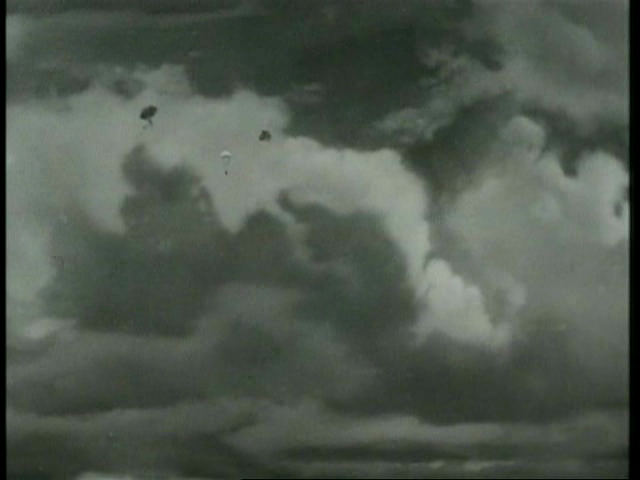
  • There is also one of the strangest shots in all of cinema - almost serene and definitely surreal - as Vladimir looks in the far distance from within the foliage, a Nazi plane is engulfed by anti-aircraft fire. Small dark-grey ruptures around the distant plane suggest misfired projectiles, until one gets the plane – it explodes in the sky and out of it, supported under a neon-white parachute, a pilot descends to safety, until ofcourse, as soon as a hysterical Vladimir wishes it – a projectile gets the pilot too. It is a picture of incredible devastation – and yet, we do not know either the pilot, or the man who fired at him from the ground. Our investment is purely sensual; much like Vladimir's. In the next scene, a comrade admonishes himfor beginning to enjoy 'violence', much like we just did.